
[ad_1]
Glassnode’s hodler internet place change metric gives a granular view into the habits of Bitcoin’s long-term traders. The metric is calculated by monitoring the inflows and outflows from wallets categorized as holders — or those that have been “holding on for pricey life” for a really very long time.
This metric is pivotal in understanding market sentiment, significantly the arrogance ranges of the traders identified for his or her long-term dedication to holding Bitcoin, no matter market volatility.
On March 19, the 30-day hodler internet place change reached -88,860 BTC, marking essentially the most vital damaging shift in three years.
This downward pattern has endured since Jan. 4, damaged solely by a short 4-day interval of constructive change on the finish of February. This appreciable lower in hodler balances comes after a pointy correction in Bitcoin’s value — which dropped from a peak of $73,000 on Mar. 13 to simply beneath $61,000 by Mar. 20.
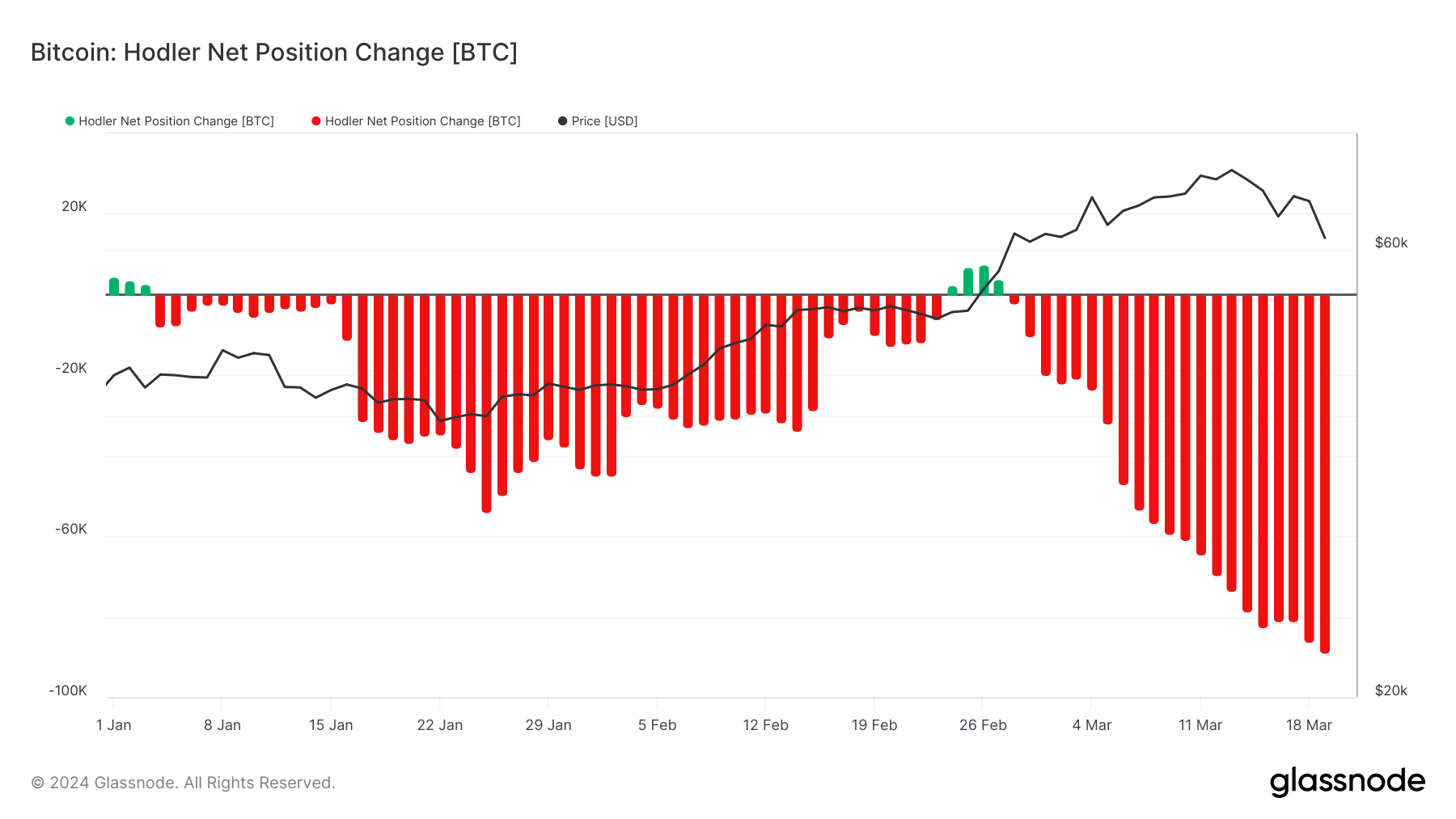
Such a big damaging change in hodler steadiness usually alerts a change in long-term investor habits and may point out decreased confidence in Bitcoin’s value stability within the close to time period. The timing and scale of those modifications can counsel a notable shift in sentiment amongst these traders, who’re typically identified for his or her resilience throughout market volatility.
Nonetheless, deciphering the state of the market via a single metric, such because the hodler internet place change, could be deceptive if different indicators aren’t thought of.
Earlier CryptoSlate evaluation discovered that regardless of the short-term value volatility and the rise in promoting stress on centralized exchanges, the underlying pattern of accumulation inside the market remained unaffected.
That is seen within the divergence between the market cap and the realized cap, indicating that the lower in market worth didn’t deter the buildup of Bitcoin, with the realized cap exhibiting a rise within the realized worth of all cash moved on the community.
Regardless of the lower in long-term holder balances since December 2023, this ongoing accumulation means that different components are at play. The decline in over-the-counter (OTC) desk balances and vital outflows from Grayscale’s ETF are potential contributors to this pattern.
OTC desks, serving large-volume merchants and establishments, facilitate main transactions with minimal market affect. A discount in OTC balances might point out that institutional traders are transferring their holdings to exchanges, presumably in anticipation of gross sales or to fulfill liquidity wants. This contributes to the damaging hodler internet place change with out essentially indicating a broad sell-off amongst particular person long-term holders.
Moreover, outflows from Grayscale’s GBTC, a key institutional automobile for Bitcoin publicity earlier than the launch of spot Bitcoin ETFs, might have considerably influenced the hodler internet place. These actions could possibly be pushed by traders reallocating to ETFs with extra aggressive charges or liquidating positions as a consequence of market situations.
The info exhibits the significance of contemplating a number of sources and on-chain metrics to realize a complete understanding of the market. Institutional actions can have outsized impacts on market indicators and should not at all times align with the sentiment and habits of the broader investor group.
The submit What’s pushing down Bitcoin’s hodler balances? appeared first on CryptoSlate.
[ad_2]